Showing posts with label Explorering. Show all posts

Venezuela was So Much

Last month was my Dad's 64th anniversary. “Ah wait, What? 64?”, I asked myself - ten times. I mentally subtracted the years and the age difference of my parents – multiple times. When I spoke with him, he told me joking “I’m turning 46, what do you mean?”. Yes, I'm not confused he is really 64. Even though my Dad is not travelling with us, he has been an important piece of this puzzle, of my travels, of my adventurous blood. He is the reason of my appreciation for the ones who leave everything behind and go, hunting for more. He is the reason why we went to Venezuela during our round the world trip.
When he was 14, 1951+14, his Mother and 6 brothers left a tiny little place in Portugal and joined his patriarch in Venezuela. He left Portugal illegally and after 10 days on a boat journey they arrived in Caracas. Back in the times the main motivation for immigration was already economic, adding up, a deep and long dictatorship and an imminent military service for the portuguese colonial war.

Work was a priority. That's what he did when he arrived in Caracas. Surrounded by an environment of entrepreneurs, family businesses and hardworking he became his own boss at a young age. In one of his rare visits to Portugal he met my Mom, they collected a bag full of love-letters, exchanged across the ocean, and they got married in his late 20s, 1951+28, in Portugal. They decided they would live in Portugal and after wrapping up in Venezuela, my Dad returned. It was time to start all over again, 1951+32.
My dad used to tell us the stories, show us pictures of his favourite places, pictures of family but we never really understood what was it like to live and work in Venezuela all those years. My mom never went to Venezuela and until recently that was the case to me and my sister. Yes, my sister joined us this August in Caracas. We gladly can say we went, we saw it, we took pictures, we now understand it (him) a little better.
Few of the same-kind-blood, that first arrived in Venezuela even before my Grandfather, never came back to Portugal. When we arrived we were welcomed by a family-crew that made our time in Venezuela unforgettable. They were with us all the time, caring for us, protecting us, helping us making dreams come true. I can't even think how it would have been without them. Thank you, all of you! Thanks to the Miami-family, even far away, they did it again <3!

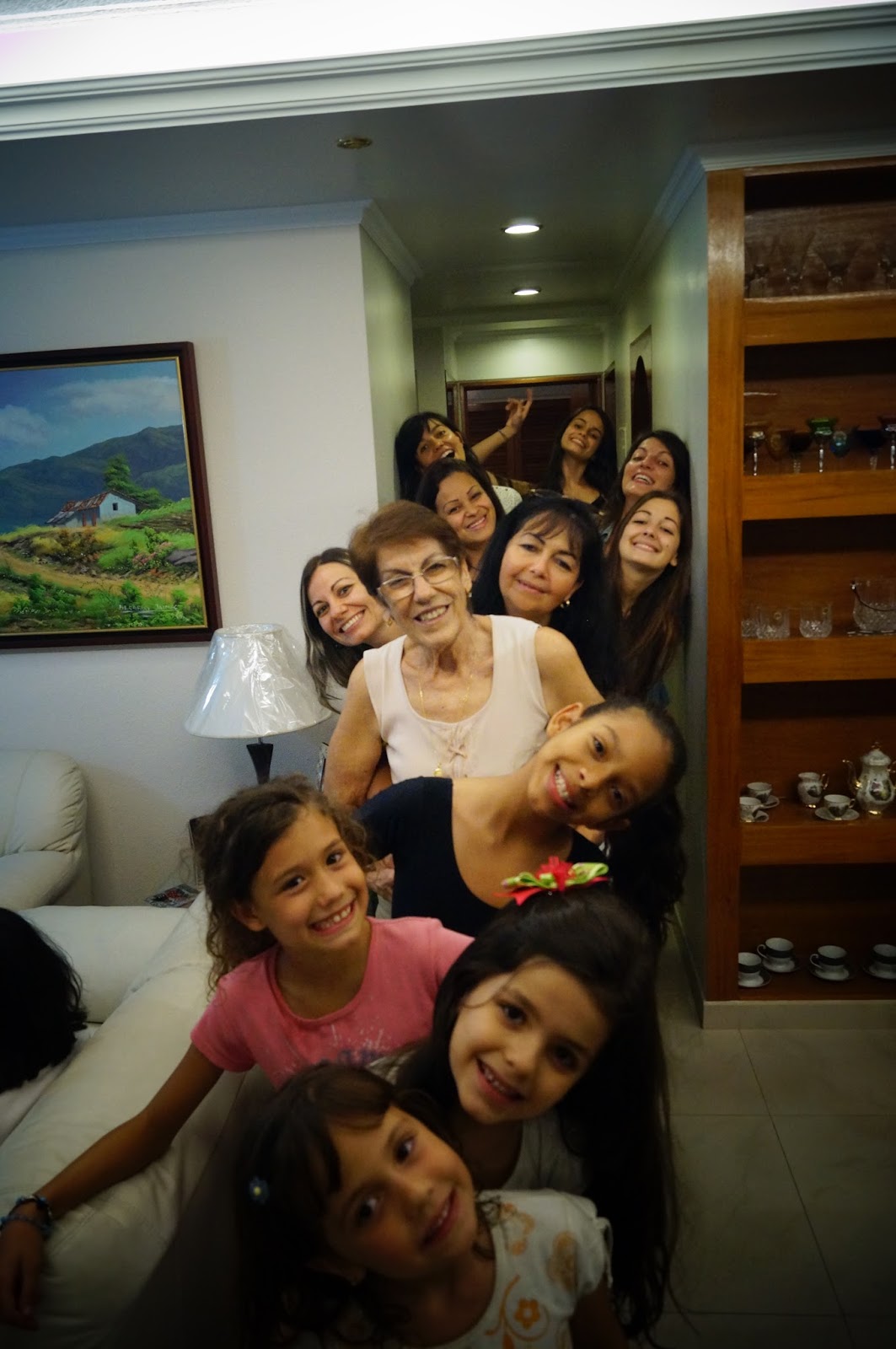


Caracas is located in a valley and it's hectic, noisy, polluted but fascinating. As it has always been to me. From the window of the 15th floor´s we could see Mount Avila, an imposing mountain that separates the city from the Caribbean Sea and shapes most of the city’s landscape. That same window presented us the packed streets, crowded highways and the uphill neighborhoods, one morning the echo of gun shots coming from those sides were clearly audible. From the same window, a little bit to the right, Chavez's banners were unwelcoming visible too. In our adventures in the city we walked through Quinta Crespo, my Dad´s old neighborhood. We hunted for the famous Ungria, the shop where his dry-cleaning business started. We gladly ate loads of arepas, typical corn-flour bread, and we poorly made them. The stories my sister and I heard all our life couldn't be more truthful. 
Venezuela is a beautiful country. With a unique and diverse nature, 40% of its territory is protected area, from beach to mountain, from rainforest to a (mini)desert. It also hosts the world's highest waterfall, Salto Angel in its extraordinary 978m high. Deep in Canaima's National Park it took us 12h bus ride from Caracas to Puerto Ordaz, 1h airplane to Canaima, 4h ride in a curiara (motorized canoe) and finally 1h hike to arrive in the most accessible part of the falls. Swimming in the small pool that forms below it was rewarding and hard to get to.


Don't be fooled by the beauty, Venezuela is unfortunately dangerous. One lives concerned, worried most of the time: your phone, your wallet, your clothes, your shoes, your life. As my father tells, around 1951+26 what was supposed to be a family weekend outside of Caracas' outskirts became an experience of survival. My Dad, his brother, uncle and cousin were robbed, kidnapped and their car hijacked. After hours of driving with no clear direction, the bandits dropped them in the middle of a pitch dark Venezuelan jungle. They thought they were going to be "shot and left to the crows", but no violence was used and they were just left behind, unharmed. Their next challenge was to find their way back, and walked for hours reaching eventually the closest pueblo, safely. Economically, the explosive and powerful country that my Dad once lived and spoke about is nowadays in imminent collapse. The economy is weak, drained, exhausted. International companies are retracting investment, (hyper)inflation is pushing small business owners to shut the door, the supermarkets lack basic products, the tourists come visit less and less. The current exchange rate is a total joke - in the black market 100 BsF, the largest country's bill, was worth 14cents of a dollar at the time. The legislative elections upcoming December (if they occur) are, to many, the last opportunity they have to hope for a change. Many, though, are already hopeless.
Venezuela is the beauty and the beast. The incredible extraordinary nature. The potential. The family history. The endurance and fear in the future. The absence of political sovereignty. The terrible economic vision and strategy. All so hard to balance and accept. Venezuela's dualities makes my chest hurt.
Eventually I realized with this trip, 1985+30, a deeper and important side of myself. With no intentions of doing so, all these years I've been ignoring a crucial side of my father's life. I realize now how influenced he was by the many years of that south american way-of-life. That Venezuela inspired his entrepreneurship and his family-business mindset. His constant fight for more and better, the ambitious and risky decisions he takes in nowadays, have been urged by many years of daring. It took me long to know the Venezuela from nowadays, by myself. But this Venezuela ignited my consciousness and respect. Now, I know (a little) better. I know that my Dad is aging, I know I'm greatly proud of his story and I'm so thankful of all he teaches me. I´m so intensively grateful.


“Sooner or later , that moment should arrive for most adult children: the startling realization that the father or mother aged.” Lionel Shriver, So Much for That

Few words to Cuba

I've been trying to write about Cuba for a long time now without success. I'm not quite sure if it's because of the duality I felt while moving around but it has been very hard for me to express my feelings about the Caribbean Island. Perhaps it's because it was just so...Everything was just so different! The decay of beautiful buildings, the amount of people lining up for milk or bread, the highly educated people we met, the lack of opportunities they have, the buzzing street nightlife, the music, the rum, the beautiful blue sea, the many happy people and their smiles, the heatwave that never went away or the mini-tiny supermarkets with empty shelves.

I was blown away by the country but when was time to leave I found myself happy, deeply relief, that I was able to do so.

I feel puzzled. While I'm trying not to forget all I experienced and at the same time expressing it somehow, I decided to say less about Cuba and instead let the photos do the talking for me.


Havana

My favorite moment of the day was when the sun was about to set and everyone was coming outside. The chit-chat between neighbors, the vendors calling for some additional pesos, the kids playing barefoot. The street life in Havana was truly unique and inspiring! 
Paseo del Prado footballers
Classics in Havana
At the back, El Capitolio, currently under renovations.
Built 103 years after the Capitol in Washington, the Cuban building used to be the house of the Government until the 59´s Cuban revolution. As a fun fact, like our proud guide mentioned to us, El Capitolio´s dome is 3,7m (12feet) taller than the American version.
Due to decades without maintenance many buildings in Havana are decaying and deteriorating, as this one even though we found a city in reconstruction as a result of UNESCO´sponsored programs. Tourism and the increase of demanding tourists has been pointed as an important reason for the shift in mindset. 
From the 12 days we were in Cuba, we only stayed in Casas Particulares - private houses licensed to host tourists. This is Centro Havana, the neighborhood we stayed. A very convenient location, easy to walk anywhere.

La Bodeguita Del Medio is a very famous restaurant-bar in Old Havana.
Back in the 40´s this was the only bar that was not located in a street-corner and therefore it was named the bar in the middle by one the its many famous personalities/customers.

Old Havana packed with tourists and young artists. The former seeking a shade from the flaming sun and the later a small extra coin.
The '59 Revolution's leader respected and adored by all. 

With 72000 square meters the Plaza de la Revolución is surrounded by the National library and many government ministry buildings. This Che Guevara tribute is the Ministry of Interior building, where once he worked as a member of the United Party of the Cuban Socialist Revolution, PURSC.

In Havana is still all about Revolution. Always. Maybe it will be forever.


Sunset in the Malecón, a seaside walk connecting Centro Havana and Old Havana. 
"Do you want to meet more Cubans? Just walk the Malecon in the evening, that's where we go for fun", told us our great guide Juan Carlos.
The view from our casa particular, a 17th floor apartment in Centro Havana. 
A city representing the country - fighting to open the doors and at the same time keep its identity. 

Cienfuegos, Trinidad, Santa Clara and Varadero


Cienfuegos main square. A peaceful seaport city with beautiful historical buildings but little to do and see. 

Cuban Carnival in Trinidad.
The cobblestone streets, the colorful colonial buildings and the nature close by make Trinidad a charming city to stay for few days.
A steam engine train travels the distance between Trinidad and Valle dos Engenios almost everyday.
Havana looked like a paradise compared with the conditions some people lived in Trinidad´s countryside.
Los Ingenios Valley, the center of sugar production from the 18th century until late 19th.
We took the picture from the top of the Manaca Ignaza tower, after a 136 steps climb and a much needed rest.
The Manaca Ignaza tower was built to observe and control the slaves working in the sugarcane fields.
Santa Clara was an important base for the ´59 Revolution and there are many, many Revolution's points to visit across the city. This is Che Guevara's Monument and Mausoleum. 
Varadero is the Cancún of Cuba. Resorts, all inclusive deals, catamarans and yachts, luxurious villas and a lot of tourists.
Do not expect to see the real Cuba in Varadero but it worth to see the deep blue sea of the Caribbean.


I know that I still did some talking about Cuba, but I guess that´s it. Go and see it by yourself, I'm sure we can talk about it after.

Where are you from?!

I don't think I ever answered this question so many times as I did since we arrived in Vietnam.

Our arrival in Hoi Chi Min City, or as it's still called by the locals Saigon, was smooth - no major problems crossing the boarder by land, no scams, better roads (wait for it, as it was false alarm), massively populated city, thousands of motorbikes, a lot of war memories and glimpses of old European cities. 

Our overall plan at that time was to spend Will's anniversary in a party city - easy to meet people, have some fun and celebrate the arrival of a new decade. We decided to do it in Nha Trang. We thought that we could even rent an apartment for few days where we could finally cook our own food, wash out the dirt of our sneakers and rest. It happened almost that way... We had to adjust it a little because Will got really ill on our way there - feeling like vomiting, vomiting, diarrhea, vomiting a little more, more diarrhea and fever. Gladly we stopped in a city called MuiNé where just wind and sand could stop us, so we did a lot of healing and -resting and yeah we paid a visit to the closest hospital to completely kill the bad-ass bug that attacked him.

MuiNé and Nha Trang are touristic cities. They have loads of restaurants, bars, Russians tourists and also loads of people ready to sell you their soul- books, fruits, drinks, sunglasses, ice cream, cigarettes, motorbike's tour, drugs. They approach you in all different kind of ways, the most common by honking or saying hello. You can ignore them, sometimes, but most of the time you can't because they move around in groups...if you say no to the first one, the next one asks you the same thing, hoping that your decision changed after 1second.

Being polite while saying no, can generate other questions too - the most common: "where are you from?!". When answered the reply is so happy - futebol, Cristiano - that even if I want to get mad, I simply can't.

We moved to Hué skipping the very touristic, shopping orientated and known for the remarkable tailors, Hoi An. Hué gave us a little more "where are you from?!" questions, with less Russians around...

And that's about it...the English level in the streets of Vietnam doesn't allow them to have a chit-chat or build up a connection. You may ask "are you from around?", and the answer is "cigarettes?! buy one from me!". Maybe they don't answer because they don't care, instead of not understanding...but that's exactly where I lose the contact and the connection with that person. And that's exactly what I'm missing in Vietnam, the connection with the people.

I wouldn't be far if I say that all Vietnamese I met are like this...not true. The further North we get, the more differences I notice (or maybe it's just me not caring much anymore). I will write a separate post about the best decision we made so far: visit the Phong Nha-Ke Bang National Park. 

Vietnam is beautiful and worth the visit. Beautiful people, funky almost-roads, a lot of growth specially in the cities, some poverty specially in the villages, loads of history to soak and shock you, loads of cheap clothes, stylish air cuts, nice very nice food, beautiful sand beaches and coast lines, and also nice people, just not as nice as in Cambodia, I warn you.


Lassi, Diana and Will, the professional travellers in Halong Bay


Já ganhou!

Sorry, today the post is in Portuguese. Started the notes in Portuguese and couldn't translate it anymore. Good luck using Google translator...

Para mim, o Camboja já ganhou. Pela comida, pelas pessoas, pela simplicidade, pela ruralidade, pela(s) beleza(S) natural(ais). Acho que principalmente pela simplicidade. 

Chegamos a Siem Riep depois de 30h de viagem (barco, autocarro, mini-van, carro), que correu bem, não tivessem uns tailandeses tentado nos "roubar" uns trocados na fronteira - drible de eu faço o visto por vocês e vocês não perdem o próximo autocarro para Siem Riep. Acabamos por ser driblados um pouco mais à frente, conscientemente.  Pagar um extra para chegarmos mais cedo ao destino era tudo o que queríamos depois de tanta hora na estrada...

À medida que nos embrenhávamos mais e mais no país o ritmo ia claramente mudando: os carros já não andavam como loucos, as bicicletas igualavam em número as motas, as pessoas sorriam um pouco menos mas continuavam de sorriso fácil. O sol escaldava ainda mais e a pobreza era escandalosamente maior. A simplicidade aumentava.

Chegamos à nossa guesthouse sem água quente, com muitos mosquitos mas com um staff sorridente e super amigável. Localizados bem no centro da cidade, rápido percebemos que estávamos numa outra fase da nossa viagem - o Camboja é diferente e nós teríamos que nos adaptar a esta nova realidade. Será que ia ser simples?!

Fizemos as partes turísticas, templos de  tuk-tuk, Angkor Wat ao amanhecer, show de dança de apsara (dança tradicional), comemos amok (cozinhado feito em folhas de bananeira) e caril de galinha (o meu favorito até agora foi o da nossa guesthouse, de longe!!! Tão bom que me queimou o céu da boca :)). Fizemos ainda uma visita aos campos de arroz, quintas de lotus e crocodilos e espreitamos o mercado local. Fora do turístico normal, alugamos bicicletas e deixamo-nos levar pela confusão do trânsito da cidade, perdemo-nos pelas estradas de areia, encontramos crianças sorridentes e faladoras. 
Turístico ou não, tudo é simples, bonito, autêntico e pobre. 
Coincidência ou não, foi em Siem Riep que passámos mais tempo até agora. Era engraçado ver a cara do staff quando perguntávamos pela manhã: "podemos ficar mais uma noite?!".


Depois deixámo-nos levar por um fim-de-semana em Battambang, a 4h de distância de Siem Riep, é uma antiga cidade colonial francesa, com a sua influência clara - o francês é mais frequente que o inglês, há baguetes em quase todos os carrinhos de comida e nas ementas dos restaurantes. 

Simples (olha a novidade!), cheia de crianças, menos turistas, Battambang também tem coisas únicas: Uma caverna de morcegos que ao final do dia saem da sua casa e dão ao céu um misto de pintura e absurdo. Há também um comboio de bambu, que de comboio só tem as linhas e pessoas maravilhosas! O Xim é um exemplo disso, contou-nos que pouco recebe ao trabalhar como professor inglês e física mas que não desiste dos seus alunos. "Nunca!", diz ele. Passa a semana longe de casa, em outra cidade, e o que lhe dá mais satisfação é saber que está a ter impacto positivo nos seus alunos e principalmente por lhes estar a proporcionar o mesmo que um dia ele teve também - acesso ao conhecimento. Muito inspirador, mesmo!


Mergulhamos em Phnom Pehn, depois de uma semana no Camboja. Como capital de um país, é cheia de tudo. Prédios altos, lixo muito lixo, pessoas com pressa, muitas marcas da guerra que arrasou o país até à bem pouco tempo...e um caos organizado à sua própria medida.
Na primeira noite fugimos disto tudo e entramos num shopping - a sensação que tive foi que tinha sido ejectada do Camboja. Parecia que estava no Colombo em Lisboa, mas a praça de alimentação tinha caracteres japoneses (havia ali alguma ligação com o Japão que não tentei entender), mas de resto tudo era igual. Acabamos por matar a vontade de ir ao cinema e experimentamos uma sessão 4D - filme terrível, experiência engraçada!
Nos dias seguintes deixamo-nos levar pelas tristes marcas da guerra civil, com o seu ápice na era dos Khmer Rouge (1974-1979) onde quase 2 milhões de Cambodianos foram assassinados. Fomos visitar a intensa e dolorosa prisão onde os presos eram detidos e torturados, assim como o descampado onde eram enterrados depois de sentenciados à morte por crimes que não tinham cometido. 
Vale a pena ler e descobrir um pouco mais desta história que teima em não ser diferente de país para país, de década para década - e infelizmente se repetir sem pudor nem perdão.


Estávamos preparados para Phnom Pehn ser mau, muito pior do que foi na realidade. Mas três dias e estávamos prontos para seguir viagem - já com o visto do Vietnam no bolso. Se passarem por estas bandas, vão ao mercado russo, caminhem pelo rio e deixem-se levar pelas cores das coisas - vale a pena!


É o Vietnam que nos espera agora e eu nem sei bem o que esperar...vou ser certamente surpreendida tal como fui com o Camboja, que já tem um lugar especial no meu coração, simplesmente pela sua simplicidade.